Method
Specification-driven development, progressive elaboration, and early architectural validation.
Dark Factory’s working method centres on three ideas, adapted from established software engineering for a delivery where most of the implementation is done by AI agents:
Write the specification before the code. Requirements are interpreted and approved as discrete, versioned items with stated acceptance criteria before any building begins, and the architecture and implementation plan are approved at a gate before development starts. When the implementer is a model rather than a person who can ask a question over the shoulder, the specification is the main channel for intent — so it is written down, reviewed, and versioned rather than assumed.
Elaborate progressively through gated phases. A delivery is broken into phases, each approved at a checkpoint before the next begins, and each phase into a small number of coherent iterations. This project’s own Phase 2 plan, for example, is four iterations: the first phase’s story and lessons; the organisation and its objective; the evidence-based account of how the project is evolving; and a final consolidation pass. Each iteration is sized so one review pass can hold its whole diff and its acceptance criteria.
Validate architecture early. Architectural decisions are validated before a large body of content or code is built on top of them — in this project, the Phase 1 checkpoint explicitly closed that phase as an architectural proof rather than a finished product. Getting a decision wrong after it has been baked into a whole site is far more expensive than getting it wrong in a small, gated slice.
The method is also shaped by the constraint of the models that do the work. The recorded Phase 1 constraint was a local-model context budget, conservatively treated as smaller than its raw figure once tool and schema definitions are carried, and the iteration sizing above is the method’s direct response to it. The evidence-bounded account of the models and coding agents involved — and which of these statements are recorded facts, observations, or plans — is on the The Factory page, under “Models and coding agents”.
This method matters more here than it might for a conventionally human-built project, for a reason the Roles page goes into: no single role creates, approves, validates, and deploys the same piece of work, and the gates are where a human retains final authority. Whether a governed process like this one scales beyond what has been demonstrated so far is a genuinely open question — the experiment is, in part, to find out.
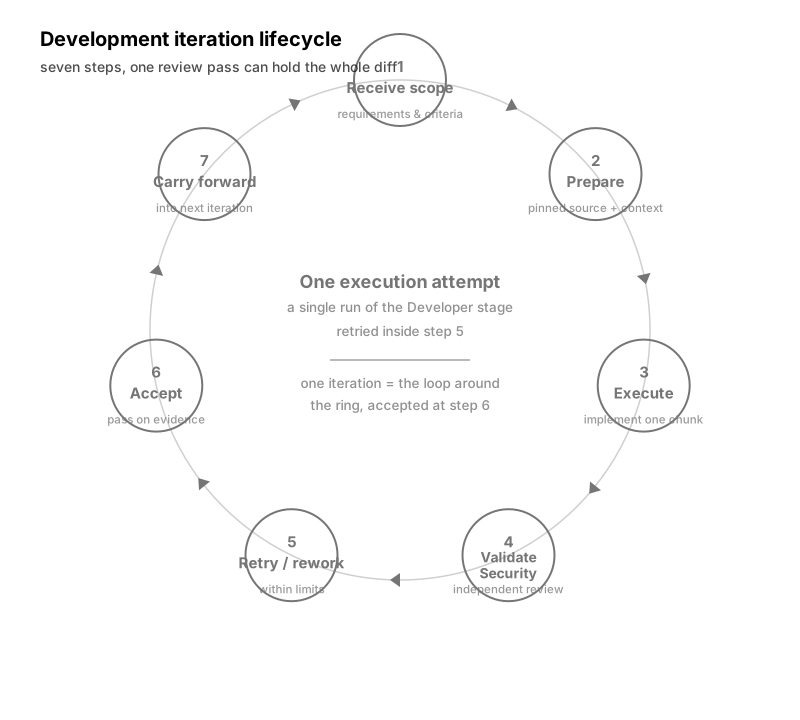
The iteration lifecycle
Each of the coherent iterations the method breaks a phase into runs the same seven steps: the scope and acceptance criteria are received, the pinned source and context are prepared, the chunk is executed, Validator and Security review it independently, any rework stays within limits, the outcome is accepted on evidence, and the accepted candidate is carried into the next iteration. The ring below marks the whole loop as one iteration, and its centre distinguishes the single execution attempt that step 5 may retry from the wider iteration it belongs to.